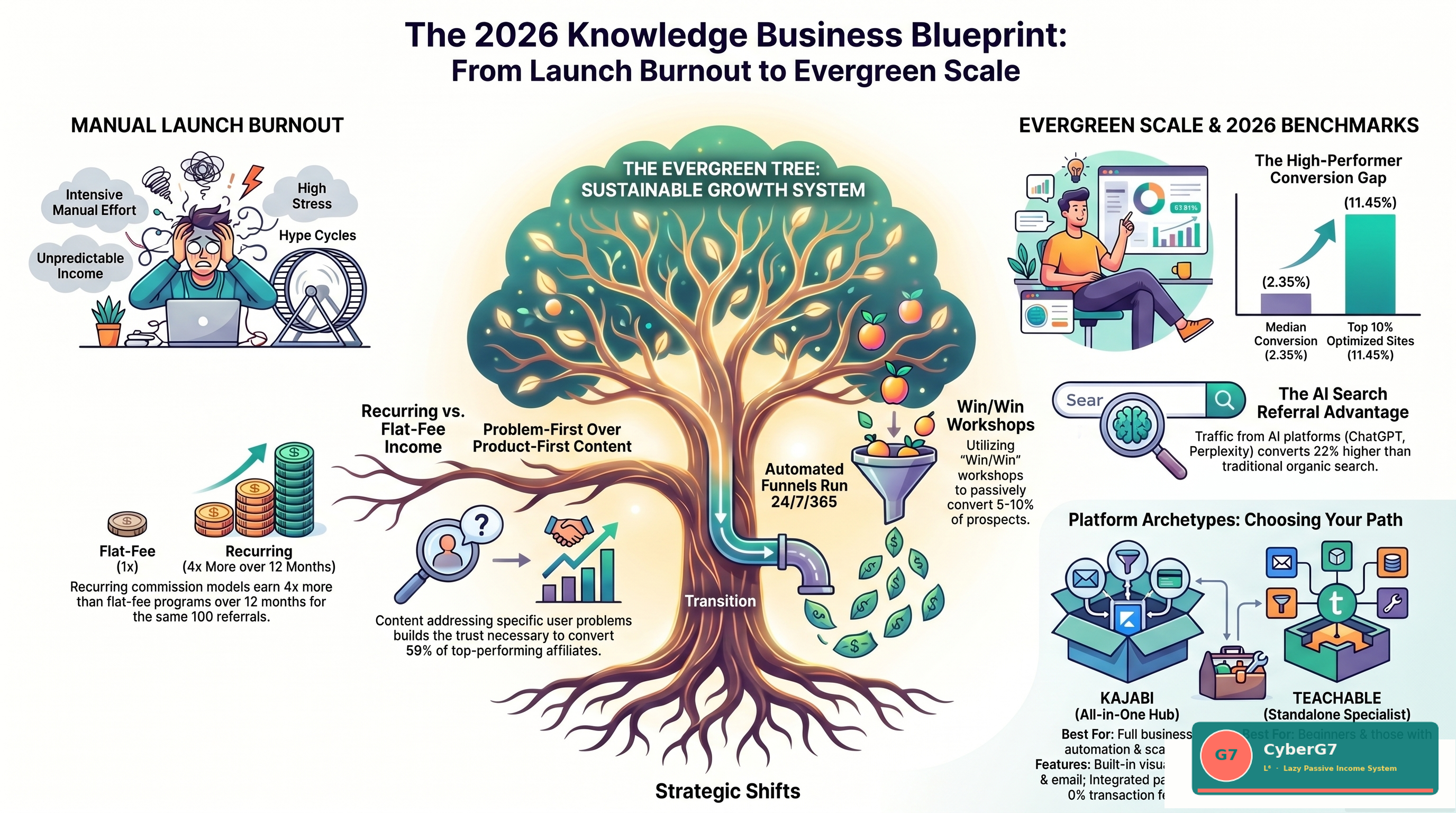
A step-by-step, AI-compressed playbook to validate a profitable topic, build an email list before you launch, produce a course on part-time hours, and turn one launch into an evergreen funnel that sells 24/7.
Get a free inside look at “Scale and Repeat: The Evergreen Funnel, Affiliates, and the Passive Income Ladder” — the module infographic and the video overview.
By the numbers
You didn't set out to trade every hour for every dollar — but that's where most creators land. They build before they validate, launch to a list too small to hit their number, then blame the product. The course-creation grind exists because people use consumer tools built for consumption, not production, and burn six months on work AI can compress into ninety days. The Lazy Passive Income System replaces the grind with a sequence: do the revenue math first, validate before you create, build the audience while you build the course, and let an evergreen funnel carry the rest.
Most online-course advice is a random bag of tactics. L6 is a sequential system where each lever activates the next: L1 Architecture (the plan and the math), L2 Idea (a validated topic), L3 Audience (a list built before launch), L4 Create (AI-assisted production), L5 Sell (a sales system that converts on autopilot), and L6 Scale (evergreen funnels and affiliates that compound). It's engineered for 10–15 hours a week because AI handles the research, scripting, copywriting, and scheduling — your job is to decide, record, and press publish.
M1 Income Architecture sets your revenue equation, AI stack, and asset mindset. M2 Profitable Idea Machine validates your niche, avatar, title, and curriculum with AI. M3 Audience-First Flywheel builds your lead magnet, email list, and brand before launch. M4 Course Production the Lazy Way scripts, records, edits, and uploads your course in weeks of part-time work. M5 The Money Machine handles value-based pricing, an AI sales page, and a 10-day launch sequence. M6 Scale and Repeat converts your launch into an evergreen funnel, affiliate channel, and product ladder.
A launch is a spike; an evergreen funnel is a river. By the end you have a validated course, a converting sales page, a 10-day launch playbook, and an automated funnel where every new subscriber — from any source, at any time — enters a sales journey that converts without your involvement. The compounding milestone is when monthly evergreen revenue equals half of one launch: the point at which your income keeps arriving whether or not you worked that week.
The course distills a proven, sequential L6 framework — Architecture, Idea, Audience, Create, Sell, Scale — where each lever has a clear definition of done and activates the next.
Every workflow uses concrete, copy-paste AI prompt templates following a Context + Request + Format + Constraints structure, so output needs roughly 20% editing rather than starting from scratch.
6 modules, each ending in a deliverable.
Six modules and 36 lessons covering the full L6 framework, plus AI prompt templates for niche research, scripting, sales pages, and launch emails, Canva-ready worksheet templates bundled as module workbooks, and a complete evergreen-funnel, affiliate, and product-ladder playbook.
The default is 90 days on 10–15 hours per week, split into Foundations (Days 1–30), Production (Days 31–60), and Launch (Days 61–90). You can compress to 60 days if you have content to repurpose and a 500+ list, or extend to 120 days if you have under 10 hours a week.
No. Module 3 builds your email list during the creation phase with an AI lead magnet, a free landing page, an AI-generated 30-day social calendar, evergreen Pinterest traffic, and personal outreach, so you launch to a warm audience.
An AI assistant (ChatGPT or Claude), Canva, an email platform (ConvertKit recommended, with a free landing-page builder), a course platform (Teachable, Kajabi, or Podia), and a social scheduler (Buffer or Later). Most have free tiers, and total recording-gear cost is $0–$100.
Module 5 uses value-based pricing: set your price at 10–25% of the 12-month dollar value of your student's outcome, typically landing courses between $197 and $997. You'll also add order bumps, upsells, and pay-over-time options that lift revenue 20–40%.
No. The niche, validation, and curriculum methods in Module 2 work for any expertise — the five-step framework turns whatever you can teach into a specific, validated positioning statement and a transformation-arc curriculum.
AI handles structure, drafts, and research; you supply the human layer — your stories, examples, and voice. The course explicitly teaches editing AI output to roughly 20% so it sounds like you, and MIT research shows AI-assisted writing improved quality by about 18% on top of the time savings.
A great lead magnet is a micro-result that previews the transformation of your paid course — a checklist, mini-guide, 5-day email course, or template that solves one problem in under 20 minutes — so subscribers think the paid course must be extraordinary.
A launch is a one-time spike to your list; the evergreen funnel is always-on. Every new subscriber enters an automated welcome sequence, then a 7-email evergreen sales sequence with a personalized Deadline Funnel deadline, converting buyers 24/7 — typically lifting evergreen conversion 15–30% over funnels without genuine urgency.
Industry benchmarks suggest roughly 1–2% conversion on cold traffic and 3–5% on warm, email-driven traffic, with top launches reaching 5–10%. The course's revenue equation uses a conservative 2% so your list-size target is built on realistic, not optimistic, numbers.
Yes — that's the design. The roadmap assumes 10–15 hours a week, and the rise of solo, part-time businesses (U.S. nonemployer firms surpassed 27 million) plus AI time savings make a one-person, part-time course business genuinely feasible.
Module 6's post-launch debrief treats results as data, not a verdict. A six-question analysis pinpoints whether your bottleneck is list size, offer alignment, or launch sequence — and data-informed second launches commonly see 2x–5x results because you're optimizing a working system, not starting over.
Affiliates promote your course to their audiences for a 30–50% commission and cost nothing until a sale converts. Your best affiliates are your own students, who promote with personal proof rather than paid testimonials — making affiliates the most capital-efficient growth channel in the system.
Yes — that's exactly who the 90-day default timeline is built for. The Audience-First Flywheel (Module 3) builds your email list during the creation phase using an AI-designed lead magnet, a free ConvertKit landing page, a 30-day AI social calendar, evergreen Pinterest traffic, and personal-network outreach, so launch day meets a warm audience instead of silence.
The 90-day default runs on 10–15 hours per week. AI compresses the time-consuming parts — research that took hours takes 30 minutes, a sales page that took days takes an afternoon, an email sequence that took a week is scaffolded in a session. If you have under 10 hours a week, Module 2 shows you how to run the 120-day version instead.
Six modules, 36 lessons, AI prompt templates, Canva-ready worksheets, and a complete evergreen-funnel playbook — your full 90-day system to build something that earns while you sleep.